Madhav Singh Solanki: Political Career and Legacy in Indian Politics
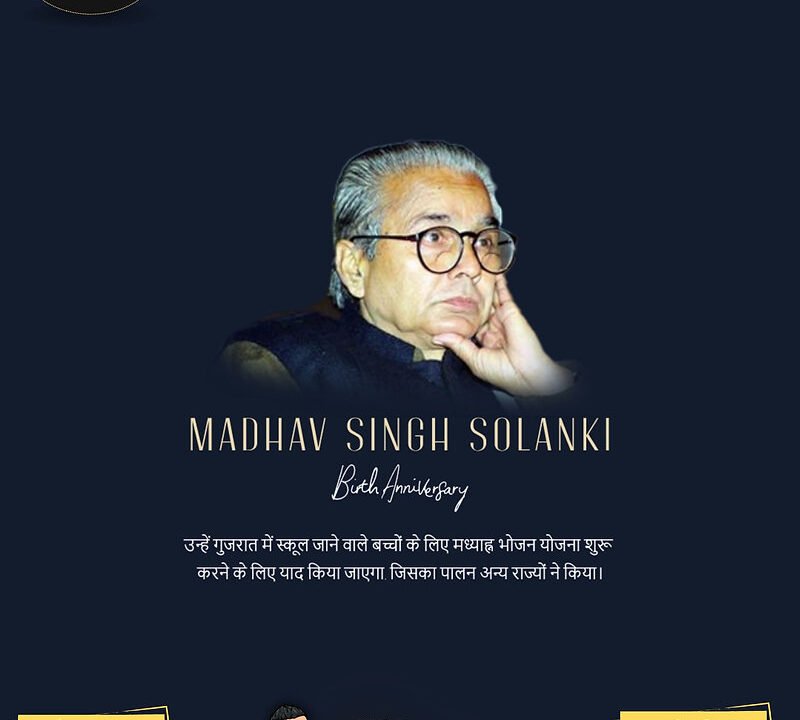
Madhav Singh Solanki was a prominent Indian politician who served as the chief minister of Gujarat and later as India’s foreign minister. His political strategies reshaped caste-based alliances in western India during the late 20th century. Readers exploring madhav singh solanki will also find context in
Solanki began his political journey in the 1950s, quickly rising through party ranks due to his grassroots connect and organizational skills. He was elected to the Gujarat Legislative Assembly for the first time in 1962, representing the Petlad constituency.
His early years in politics were marked by a focus on rural development and social justice. He advocated for land reforms and better access to education for marginalized communities, laying the foundation for his later electoral strategies. Madhav Singh Solanki – grokipedia.com
Chief Minister of Gujarat and the KHAM Strategy
Madhav Singh Solanki became chief minister of Gujarat in 1976, leading a Congress government during a period of political instability. His tenure was defined by the implementation of the KHAM strategy—an acronym for Kshatriya, Harijan, Adivasi, and Muslim communities.
This political framework aimed to consolidate support from backward and minority groups, reducing the dominance of upper-caste voters in Gujarat’s politics. The strategy proved effective in the 1980 and 1985 state elections, where Congress achieved landslide victories.
Under Solanki’s leadership, the government introduced several welfare schemes targeting education, healthcare, and employment for disadvantaged sections. However, the 1985 election victory was followed by widespread caste violence, leading to his resignation amid political pressure.
Despite the controversy, the KHAM model influenced political mobilization across India, particularly in states with similar social hierarchies. It demonstrated how caste arithmetic could be leveraged to build durable electoral coalitions.
National Role as Foreign Minister
In 1991, Madhav Singh Solanki was appointed India’s external affairs minister under Prime Minister P. V. Narasimha Rao. His tenure coincided with a transformative period in global politics, including the end of the Cold War and India’s economic liberalization.
As foreign minister, Solanki focused on strengthening bilateral ties with neighboring countries and expanding India’s diplomatic presence in Africa and the Middle East. He emphasized non-alignment while adapting to a unipolar world order.
One of his notable contributions was advancing dialogue with Pakistan, though progress remained limited due to ongoing tensions over Kashmir. He also supported India’s bid for a permanent seat in the United Nations Security Council.
Solanki’s diplomatic approach reflected his pragmatic style—balancing idealism with realpolitik. His experience in domestic coalition-building informed his handling of complex international negotiations.
What Is Confirmed and What Remains Unverified
His appointment as foreign minister in 1991 is also a matter of public record, as is his representation of the Surendranagar constituency in the Lok Sabha during that time.
However, the long-term social impact of the KHAM strategy remains debated. While it empowered backward classes politically, critics argue it deepened caste identities and contributed to communal polarization in Gujarat.
Details about his personal life and post-ministerial activities are less widely reported. There is limited public information on his later years, though he remained active in party affairs until the early 2000s.
Why His Political Legacy Still Matters
Madhav Singh Solanki’s career offers critical insights into the evolution of identity-based politics in India. His KHAM model demonstrated how regional leaders could reconfigure electoral landscapes by aligning with marginalized groups.
For contemporary political analysts, his tenure highlights both the potential and pitfalls of caste-based mobilization. It underscores the importance of inclusive governance while cautioning against the instrumentalization of social divisions.
His dual experience in state and national politics provides a case study in policy continuity across different levels of government. From rural development in Gujarat to foreign policy in New Delhi, Solanki navigated diverse challenges with a consistent focus on coalition-building.
Understanding his legacy helps explain current political dynamics in western India, where caste and community remain central to electoral outcomes. His strategies continue to influence party campaigns and alliance formations.
Madhav Singh Solanki passed away in 2021, leaving behind a complex but significant imprint on Indian political history. His life reflects the shifting contours of democracy, identity, and power in post-independence India.